Master Service Agreements in Engineering: Improving Project Delivery & Efficiency
In many engineering environments, the challenge is not identifying the work that needs to be done. It is getting the right support in place at the right time to execute it.
Projects move quickly. Priorities shift. Resource quantities change. When engineering support is required, delays in procurement or contracting can slow progress before the work even begins.
This challenge is not unique. Industry research shows that inefficient contract management can cost organizations up to 9 percent of annual revenue, often driven by delays, rework, and administrative burden (World Commerce & Contracting).
Master Service Agreements are designed to remove that friction.
What a Master Service Agreement Actually Is
A Master Service Agreement, or MSA, is an overarching agreement that establishes the framework for how engineering services are delivered.
It defines the commercial terms, conditions, and agreed-upon rates for a set period. Once in place, it allows clients to request engineering support as needed without renegotiating terms for each individual scope.
When a need arises, the focus shifts directly to defining the work. With the contractual structure already established, engineering services can begin as soon as the scope is confirmed.
Where MSAs Provide the Most Value
MSAs are not limited to a specific type of project or phase.
They can support early-stage studies, detailed engineering, construction support, and commissioning. This flexibility allows clients to engage engineering support across the full lifecycle of a project without interruption.
At the Alamos Gold, Young-Davidson operation, a BESTECH MSA structure enables multidisciplinary support across electrical, mechanical, civil, structural, automation, and IT systems. This allows projects to move quickly from planning to execution, without repeated procurement cycles slowing progress.
This type of model is particularly valuable in operations where capital projects, sustaining work, and operational improvements occur simultaneously.
How MSAs Improve Project Delivery
MSAs do not change how engineering work is executed. The same technical processes, standards, and quality controls still apply.
What they change is how easily that work can be initiated.
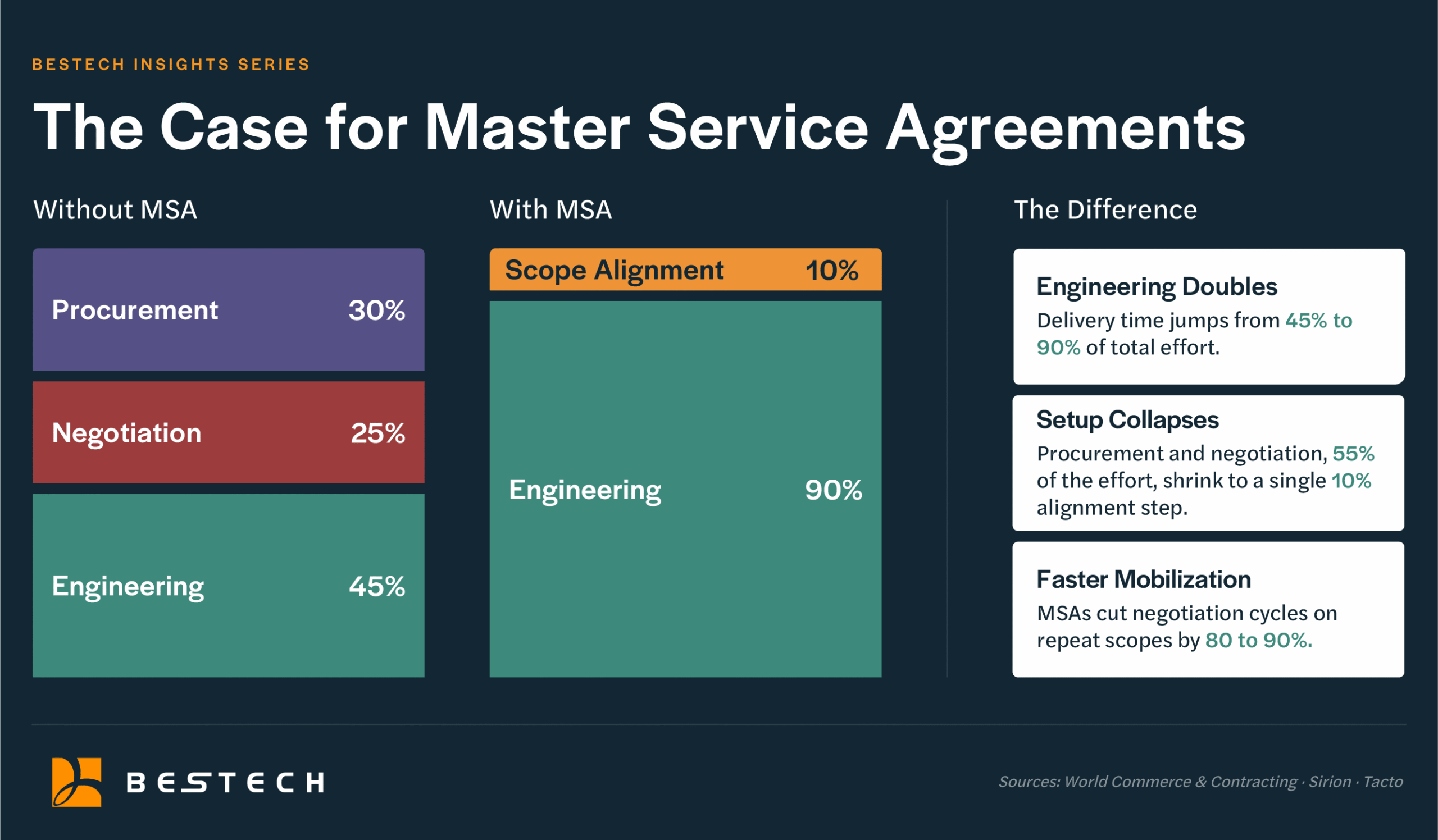
Without an MSA, each new scope often requires a full procurement cycle. This can involve preparing tender documents, issuing requests for proposals, evaluating submissions, and finalizing contracts. Even for relatively small scopes, this process can take valuable resources and, when there are resource constraints, introduce delays.
With an MSA in place, those steps are already complete. Engineering support can be mobilized quickly, allowing teams to respond to project needs without delay. In many cases, MSAs reduce negotiation cycles for subsequent scopes of work by 80 to 90 percent, allowing teams to focus on execution rather than contract setup (Sirion).
A strong example of this approach is BESTECH’s long-standing Master Service Agreement supporting Vale’s North Atlantic operations. Originally established in 2013 and renewed once again in 2026, the agreement reflects Vale’s continued confidence in BESTECH and its ongoing decision to select our team for multidisciplinary engineering support across a wide range of capital, sustaining, and operational initiatives.
Because the framework is already established, Vale can access civil, structural, mechanical, electrical, and automation expertise through a single point of contact, enabling consistent delivery and efficient execution across projects of varying size and complexity.
Responding to Real-Time Project Needs
One of the most practical advantages of an MSA is the ability to respond to changing conditions.
In one case, a client experienced a gap in their internal team when a key resource moved on before a replacement was in place. Through an existing MSA, BESTECH was able to second an engineer to act as a client representative on a full-time basis.
Because our team regularly partners with this client, we were already familiar with their standards, assets, and operational constraints. This allowed the transition to happen quickly and with minimal disruption.
The result was continuity. Projects continued to move forward, and the client was able to maintain progress toward their annual targets.
Reducing the Burden on Client Teams
MSAs also reduce the administrative burden associated with project delivery.
Without an agreement in place, internal teams often spend significant time on procurement activities. This includes developing scopes for tender, coordinating with purchasing, and managing the evaluation process.
With an MSA, that effort is significantly reduced. Clients can reach out with a specific challenge and engage support quickly, without going through a full tendering or quotation process. In procurement environments, standardized agreements such as MSAs can reduce negotiation effort by up to 70 percent across repeat engagements (Contract Corridor).
This allows project teams and purchasing groups to focus on execution rather than administration.
Supporting Critical Infrastructure & Ongoing Operations
MSAs are particularly effective in environments where infrastructure must be maintained, upgraded, and adapted over time.
For a Northern Ontario utilities company, BESTECH supported multiple critical infrastructure initiatives under an MSA, including transformer replacements, pole upgrades, and asset condition assessments. The agreement enabled rapid mobilization, allowing engineering assessments, design development, and construction-ready deliverables to be completed efficiently.
By structuring the work this way, the client was able to prioritize upgrades, execute construction internally, and maintain reliability across their distribution network while meeting regulatory requirements.
This type of engagement highlights how MSAs support not only project delivery, but also long-term system performance and resilience.
What Makes an MSA Successful
The effectiveness of an MSA is not determined by the agreement itself, but by how it is used.
Successful MSAs are built on strong working relationships and a clear understanding of the client’s operations. When engineering teams are familiar with site standards, existing infrastructure, and operational priorities, they can integrate more effectively and deliver value more quickly.
Consistency also plays a role. When the same team supports multiple scopes over time, knowledge is retained and applied across projects. This leads to more efficient execution and better overall outcomes.
Supporting Projects When It Matters Most
MSAs are particularly valuable when project needs change quickly.
On the Crushing Phase 2 project, Vale found themselves in a situation where their existing project engineering provider could not meet the required schedule. With a critical shutdown window approaching, there was limited time to respond.
Through an established relationship, BESTECH was able to step in, quickly align on scope, and begin supporting the project. This allowed the client to maintain momentum and work toward meeting their shutdown schedule.
In situations like this, the ability to act quickly can have a direct impact on project success.
A Practical Approach to Using MSAs
For organizations considering an MSA, the starting point is understanding how often engineering support is required and how variable that demand is.
If projects are frequent, timelines are tight, or scopes evolve over time, an MSA can provide a more efficient and flexible way to access engineering services.
The goal is not to replace traditional contracting methods, but to create a structure that supports faster, more responsive project delivery where it is needed.
Enabling More Efficient Project Delivery
Master Service Agreements are ultimately about reducing friction.
They allow engineering teams and clients to focus on the work itself rather than the process required to initiate it.
By establishing the framework upfront, MSAs create a more efficient path to delivering engineering support. For organizations managing ongoing or evolving project portfolios, this can lead to faster execution, reduced administrative effort, and more consistent outcomes.
–
Prepared in collaboration with Kerry Loken